Features
Aspen celebrity wedding record: reading a Colorado license
Aspen celebrity wedding record: the Colorado license steps, the three dates a Pitkin County license creates, and how they confirm or correct a timeline.
What to take away
- An Aspen celebrity wedding record usually points to a Pitkin County marriage license, not to a ceremony program.
- Colorado has no waiting period and no blood test, so a couple can apply and marry the same day.
- The Pitkin County Clerk and Recorder issues the license; the couple, officiant and witnesses complete the ceremony.
- The clerk returns the record to the Colorado Department of Public Health and Environment, which keeps the state file.
- Aspen dates cluster in summer and around the winter holidays, which is why so many timelines land in June, July, September and December.
- A license date, a ceremony date and a registration date are three different entries. Do not merge them.
Why Aspen and Pitkin County recur in celebrity wedding timelines
Aspen is a small city in a large county. Pitkin County has roughly 17,000 residents, and its clerk handles a modest number of marriage licenses each year. That small volume is exactly why the county shows up so often in a celebrity weddings timeline: a license issued there is a discrete, findable event.
The city also has a short list of venues that hold a wedding party without drawing a crowd. The Hotel Jerome, the Little Nell, the St. Regis Aspen and the Aspen Music Festival campus have all hosted private ceremonies.
Maroon Bells and the summit areas of Aspen Mountain and Aspen Highlands sit inside the White River National Forest, where a small ceremony needs a special use permit from the U.S. Forest Service, through the forest's Aspen-Sopris Ranger District.
That mix of privacy and paperwork is the story. A couple can fly in, apply at the clerk's office in the Pitkin County Courthouse on Main Street, marry the same day, and leave. The record stays.
For readers tracing a claim, the county is the first stop, not the last. A license number, a date and two names are enough to anchor a timeline entry. Everything else, from guest lists to reception photos, is secondary.
Pitkin County marriage license steps, start to finish
At least one of the parties must apply in person before the clerk and recorder or a deputy clerk; a party who cannot appear completes a notarized affidavit instead. In Aspen that means the Pitkin County Clerk and Recorder's office, in the courthouse at 530 East Main Street.
Bring government photo identification for each person. A passport, a state driver license or a military ID works. If either party has been married before, bring the dissolution or death record that ended the prior marriage. The clerk will ask for the date the prior marriage ended.
The license fee is paid to the Pitkin County Clerk and Recorder when the license is issued; the figure one Colorado clerk publishes is in the step list below. The rules themselves come from Colorado's Uniform Marriage Act, in Title 14, Article 2 of the Colorado Revised Statutes, which is why every county clerk applies the same steps.
Here is the license-to-ceremony sequence in order, under the state rules every Colorado county clerk applies:
- Both parties complete and sign the marriage application form, and at least one of them applies in person with valid ID such as a driver's license, passport or military ID.
- The clerk issues the license and charges the fee; a Colorado county clerk's license page, Washington County's, lists the fee as $30.00, says the license is valid upon issue and must be used, in Colorado, within 35 days, and says the officiant must return the completed license within sixty-three days (63) after the ceremony, with a $20.00 late fee and a further $5.00 per day up to a maximum of $50.00 for failing to do so.
- The ceremony takes place anywhere in Colorado inside the 35-day window.
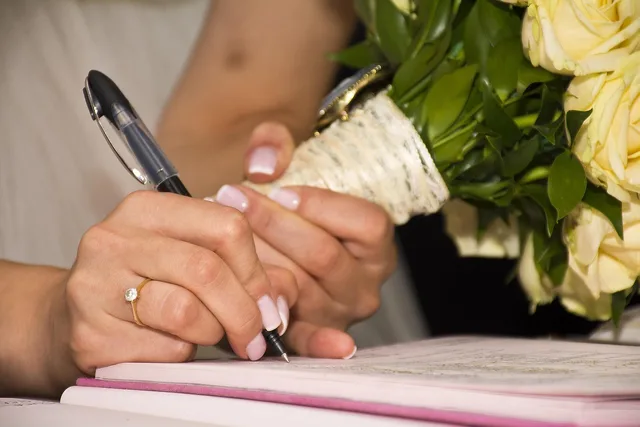
- The person who solemnized the marriage completes the license, with the county and location, the date, their signature and title, and the couple's signatures.
- The completed license goes back to the issuing clerk, who records it.
Pitkin County license to ceremony
- Apply in person at Clerk and Recorder
- Pay fee, clerk issues license
- Hold ceremony, no waiting period
- Officiant, couple, two witnesses sign
- Return license to clerk for recording
The witnesses are a real requirement in Colorado. Two people aged 18 or older must watch the ceremony and sign. An officiant can be a judge, a retired judge, a clergy member or any person the couple chooses, and Colorado does not require the officiant to register with the state.
The license itself is valid for 35 days from the date of issue. If the ceremony does not happen inside that window, the license expires and the couple must apply again. That 35 day limit is a common source of error in timelines that assume a license date equals a wedding date.
Worked example. Kevin Costner married Christine Baumgartner on September 25, 2004, at his ranch in Aspen, Colorado. That is the ceremony date, and it is the date most timelines carry. The record behind it is a Colorado marriage license. Requested with both names, the date and the county, it shows the two dates a timeline usually lacks: when the license was issued, and when the completed license was returned and recorded. On the timeline, the entry then reads: license issued (date from the record), ceremony September 25, 2004 at the Aspen ranch, license recorded (date from the record), each row citing the document it came from.
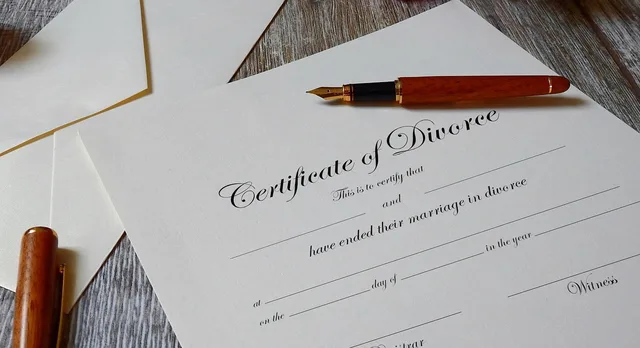
Three dates now exist for one wedding: issue, ceremony and return. A timeline that lists only one of them is incomplete. The same couple's timeline later gained two more dated entries: Baumgartner filed for divorce in May 2023, and the divorce was finalized on February 20, 2024. Those come from a court file, not from the clerk, and belong in rows of their own.
Colorado's no-waiting rule and what it permits
Colorado is one of the states with no waiting period between the license and the ceremony. The Colorado no-waiting rule means a couple can apply, receive the license and marry on the same day. There is no blood test requirement either.
Colorado vs waiting-period states
Colorado
- License to ceremony
- Same day allowed
- Blood test
- Not required
- Same-day record
- Ordinary
- What proves marriage
- Returned signed license
Waiting-period states
- License to ceremony
- Must wait
- Blood test
- Sometimes required
- Same-day record
- Red flag
- What proves marriage
- Returned signed license
This matters for reading a timeline. In states with a waiting period, a license date and a ceremony date cannot be the same. In Colorado they can. A same-day Aspen wedding is legal and common, especially for couples who arrive for a short stay.
The rule also removes one excuse for a rushed timeline. If a record shows a license issued and a ceremony held on the same date, that is not a red flag in Colorado. It is ordinary.
What the rule does not do is create a record by itself. The license is permission. The ceremony creates the marriage. The signed license, returned to the clerk, is what proves it. A couple who obtains a license and never holds a ceremony is not married, and no marriage record exists.
Colorado also recognizes common law marriage in limited circumstances, but a license and ceremony produce the cleaner record. For timeline work, the license route is the one to check first.
The Colorado Department of Public Health and Environment record route
The Colorado Department of Public Health and Environment holds the statewide vital records file. Its vital records office keeps marriage records that county clerks submit. That is the route to a certified copy if the county cannot help or if the couple married years ago.
The state office handles requests by mail and online, with fees and processing times set by the department. A request needs the names of both parties, the date of the marriage and the county where the license was issued. If the county is unknown, the state can still search, but the search takes longer.
For a timeline, the county record is usually enough: it carries the issue date and the recorded date that the state file repeats.
The National Center for Health Statistics runs the National Vital Statistics System, which describes how state marriage records are collected and reported. The NVSS overview explains that marriage data come from the states, not from a single federal register.
Federal standards shape the forms the states use. The US standard certificates that model Colorado marriage records set the fields that appear on a license and on the record returned to the state. Those fields include the date of marriage, the county, the officiant and the signatures.
For a reader outside Colorado, the practical route is the same. The CDC's guide to where to write for vital records lists the state office to contact for a Colorado marriage record. Start with the county clerk, then the state, then the CDC list if the state address has changed.
Season, venue and privacy: what Aspen adds to a timeline
Aspen has two wedding seasons. The summer season runs from late June through September, when the wildflowers are out, the trails are open and the days are long. The winter season runs from December through early January and again in February and March, when the town fills for the holidays and the ski weeks.
The Aspen seasonal wedding pattern shows up in the records. Clerks issue more licenses in the warm months and around the winter holidays than in the shoulder weeks of April, May and November. A timeline entry dated in late September or late December is consistent with that pattern. One dated in early May is possible but less typical.
Venue choice affects how much of the event becomes public. A ceremony at a hotel generates a guest list, a menu and sometimes a photo. A ceremony at a private home or on forest land generates almost nothing beyond the license. That is why some Aspen weddings appear in timelines as a single date with no detail.
Privacy is part of the appeal. The county has no press office for weddings, and the clerk does not publish a list of licenses. A record is available to the parties and to anyone who requests it with the right details, but it is not announced.
That gap between a private record and a public timeline is where errors start. When you are checking a Colorado record or california celebrity marriage records, ask which document the date came from. A record request needs both names, the date and the county, so a date in a timeline can be checked against the file.
These entries accumulate across a year. The celebrity weddings history of the same mountain towns shows the same clustering: high-profile dates in Aspen, Jackson Hole and other resort counties, usually in the two Aspen seasons.
Reading an Aspen wedding date honestly
A single date in a timeline is a claim. Treat it as one until a record supports it. The strongest support is a certified copy from the Pitkin County Clerk and Recorder or the state vital records office.
Three checks for a wedding date
- Does the date fall in an Aspen season?
- Is it a license date or ceremony date?
- Does the county match the venue?
The second strongest support is a contemporaneous public filing, such as a license application reported by a local outlet. The weakest is a photo caption with no date and no location.
Three checks settle most disputes. First, does the date fall in an Aspen season? The Costner and Baumgartner ceremony on September 25 sits at the end of the summer season. Second, is the date a license date or a ceremony date? Third, does the county match the venue? A ceremony in Aspen is almost always a Pitkin County license, but a couple who married elsewhere in Colorado may have a license from another county.
Be careful with the word wedding. It can mean the ceremony, the reception or the whole trip. In a timeline, the useful meaning is the ceremony, because that is the event the license records.
It also helps to separate what a marriages record can prove from what it cannot. A record proves names, date, county and officiant. It does not prove who attended, what was spent or whether the couple is still together. Those belong to a different kind of entry.
When a past event resurfaces, the risk is that an old date reads as current. That is the problem a good chronology solves: keep the original date attached to the original event, and mark any later development separately.
For readers who track announcements rather than records, the lessons in celebrity weddings announcements apply to Aspen entries too.