Rules
How marriage records are verified for a couple's timeline
How marriage records are verified before a couple's timeline cites a wedding: what an index line, a certificate, a state copy and a surname change prove.
What to take away
- Each document in a marriage file answers one question. An index line says a record exists, a certificate shows who signed, and a state copy confirms the record was filed.
- A surname change recorded by the Social Security Administration corroborates a sequence of names. It never proves a wedding happened.
- Federal marriage numbers describe a year. They never name a couple, so they cannot confirm one.
- "Record located" and "marriage confirmed" are different labels. Use the second only after the certificate, not just the index, has been seen.
- "No record found" does not mean "no marriage occurred". Indexes have gaps and some records are confidential.
- Verification settles whether an event was registered. It does not settle whether a relationship was happy, exclusive, or long.
Six documents, six different questions
A wedding date in a couple's timeline is only as good as the record behind it. A marriage claim is verified one question at a time, and no single document answers all of them.
The county index answers whether a record exists. The certificate answers who signed. The state copy answers whether the record was filed. The remaining documents answer narrower questions still.
The word verified hides three different jobs. A county clerk checks that a license was issued and a certificate returned. A state vital records office checks that the certificate was filed and can issue a certified copy. A federal statistical agency checks nothing about one marriage; it counts events and publishes totals.
| Document | Who holds it | The question it answers | What it cannot answer |
|---|---|---|---|
| County index line | County clerk | Does a record exist, and under what number? | Who the two people are beyond a name |
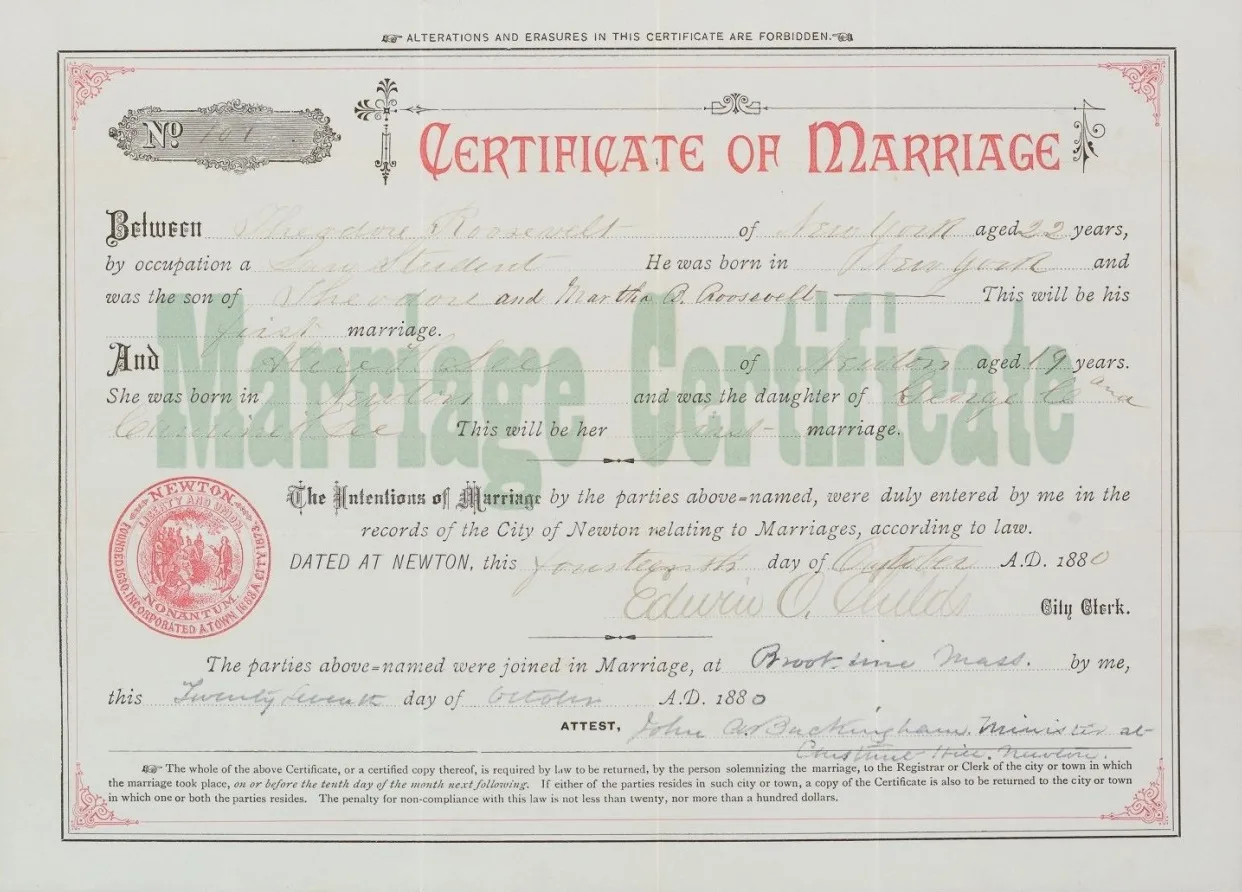
| Certificate on file | County clerk | Who signed, and who officiated? | Whether the couple stayed married |
| State certified copy | State vital records office | Was the certificate filed and kept? | Why the couple married or when they split |
| Surname record | Social Security Administration | Did a person adopt a new surname? | Whether a wedding caused it |
| Published counts | NCHS, the federal statistics office | How common was the event that year? | Whether one named couple married |
| Divorce petition | Court | What did one party state about the marriage? | The marriage date, as a record |
Three layers, three jobs
County clerk
- Verifies
- License issued, certificate returned
- Holds
- Marriage certificate on file
- Use for timeline
- Strongest single document
- National registry
- No
State vital records
- Verifies
- Certificate filed, copies issued
- Holds
- Copy of registered record
- Use for timeline
- Confirms filing, controls access
- National registry
- No
Federal NVSS
- Verifies
- Nothing about your marriage
- Holds
- A number, not a document
- Use for timeline
- Context only, never proof
- National registry
- No
Marriage registration in the United States is a state function. There is no national marriage registry, and no federal agency can hand you a certificate. Each state divides the work its own way, so the office that holds a record is the one to name.
That is why a good timeline entry names the office, not just the state. "Married in Nevada" is weaker than "license recorded by the Clark County Clerk." The office is the thing a reader can check, and the table above shows which office answers which question.
Timelines go wrong at this point when they cite a magazine and treat the magazine as the record. A magazine is a claim. The clerk's index is a record. Knowing how celebrity wedding records are compiled and checked starts with knowing which of the two you are holding.
What an index line proves, and where it stops
An index line proves one thing: a record exists, and here is where to find it. It is a finding aid, not the record. When a timeline entry rests on a single index line, the entry is only as strong as that line.
Index entry vs full certificate
Index entry
- Names of parties
- Yes
- Date or license date
- Yes
- Book, page, cert number
- Yes
- Ages, birth dates
- Usually not
- Parents, addresses
- Usually not
- Signatures
- No
Full certificate
- Names of parties
- Yes
- Date or license date
- Yes
- Book, page, cert number
- Yes
- Ages, birth dates
- Yes
- Parents, addresses
- Yes
- Signatures
- Yes
A county clerk marriage index entry usually gives names, a date, and a certificate or license number. It rarely gives ages, birth dates, parents' names, addresses, or the signatures on the license. Those live on the license and certificate, which have to be requested separately.
That gap trips up researchers. Two people with common names can appear in the same county index in the same year, and the index alone will not separate them. The certificate number does that work, and only the full record shows the identifiers that tie a name to a person.
Coverage is uneven. Large counties such as Los Angeles County, through its Registrar-Recorder/County Clerk, publish searchable indexes online going back decades. Smaller counties may have digitized only recent years and send older requests to a physical book. Some indexes are free to search; others sit behind a paid portal.
Confidentiality rules vary by state as well. Some states restrict index access for recent years, or limit searches to the parties named on the record. A closed index is not evidence that no marriage occurred. It means the index is not public at that point in time.
So the index earns a narrow label. For a chronology, cite the index for the date and the certificate number, and cite the certificate for everything else. Mixing the two is how a timeline ends up asserting facts the document never stated.
What the clerk's paperwork check covers
The check a clerk performs is a paperwork check, not an investigation. Its value for a timeline is that it is routine and written down. That makes the register entry the point where a rumor turns into a citation.
When a couple applies, the clerk compares the names on the application against government-issued photo identification, usually a driver's license or a passport. The clerk then records the details the state's form asks for. Those details are what a certificate later repeats.
After the ceremony, the officiant signs the license and returns it. The clerk's staff confirms that both parties signed, that the officiant is authorized to solemnize marriages in that state, and that the license came back before it expired. Some states also require the officiant to be registered with the county beforehand.
The clerk then records the marriage in the county register and assigns the certificate number. That register entry is what a marriage index points to. A license that was issued but never returned leaves an index line and no registered marriage, which is why a researcher should confirm the certificate came back.
What the clerk does not check is the relationship itself. No office confirms that a couple lived together, that either party had not married before, or that the marriage lasted. Everything the register does not record stays a claim until another record backs it.
When the state copy adds weight, and when it only adds a stamp
The state copy adds one thing the county index cannot: confirmation that the record was filed and remains on file. A county index line can be a license that was never returned. A state copy confirms that registration happened.
Authorized vs informational copy
Authorized copy
- Who may obtain
- Named parties, parents, legal reps
- Facts shown
- Same facts
- Stamp
- Usable for identity
- Timeline value
- Content
Informational copy
- Who may obtain
- Anyone else
- Facts shown
- Same facts
- Stamp
- Not usable for identity
- Timeline value
- Access and provenance
California shows the pattern clearly. The California Department of Public Health, Vital Records maintains marriage records for events occurring in California and issues certified copies. It works under a rule that a county index does not carry: the difference between an authorized copy and an informational one.
An authorized copy is available to the people named on the record, their parents, and certain legal representatives. Anyone else can generally obtain an informational copy, which is stamped to say it cannot be used for identity purposes. Every state draws that line in its own place.
For a timeline, that distinction is mostly about access, not content. Both copies show the same facts. The stamp tells you who was allowed to hold the document, which is worth noting if a copy surfaces in unusual hands.
One more California point shapes what a researcher can conclude. Confidential marriage records, a separate category authorized by California's Family Code, are not public at all and can only be obtained by the parties. If a couple used a confidential license, no public index will show it.
That is the clearest case for the label "no record found". A search that returns nothing may reflect a confidential record, a closed index, or a gap in digitization. It does not show that the wedding never took place.
Why federal numbers never confirm a couple
The National Center for Health Statistics sits inside the CDC and runs the National Vital Statistics System. It does not store marriage certificates. Its job is to standardize what states collect and to publish aggregate numbers.
How the standard form travels
- NCHS revises U.S. Standard Certificates
- States adopt or model their own forms
- County clerk issues license and registers certificate
- State vital records office files the record
- NVSS publishes counts, rates, trends only
The system publishes counts, rates, and trends, not individual records. The CDC states that marriage rates calculated from provisional counts come from the state health departments. A federal figure therefore describes a year, never a couple.
If a timeline cites "federal records" as proof that two people married, that citation is wrong on its face. The most the federal layer can support is context, such as a statement that marriage rates rose or fell. Context is useful and useless as proof of a specific wedding.
The federal layer does shape what states ask at the counter. The model forms behind the U.S. Standard Certificates are revised periodically with input from state registrars. States are not required to adopt them, but many model their own licenses on the template so data can be compared across states.
Data access is tiered. Published reports and aggregate tables are public and can be cited without any application. Files that could identify individuals, even with names removed, sit behind an application and a review. Provisional counts appear first and final numbers follow, sometimes a year or more after the events.
Federal law, including the confidentiality provisions of the Public Health Service Act, governs what the statistical system may publish. A record can be fully open at the county counter and still not appear in any federal file. For proof of one marriage, go back to the county.
Reading a surname change as corroboration
A license application usually asks for the surname each party will use after the ceremony. That answer is a statement of intent, not proof of a change. The change itself happens later, when the person updates their records.
The Social Security Administration is the main cross-check. A person who takes a new surname typically applies for a replacement Social Security card in the new name, and the agency records the change against the same Social Security number. That ties a new name to an old identity.
Three documents, three questions
- County clerk index: date and certificate number
- Certificate: identifying details and officiant
- SSA record: name actually in use afterward
- Name change is corroboration, not confirmation
- Missing SSA record proves nothing
If a timeline shows a performer appearing under a different surname after a certain year, an SSA record in the new name, paired with a marriage record in the old one, supports the sequence. The two together show a name moving from one form to another in order.
It still does not prove a wedding. A person can change a name for reasons unrelated to marriage, and the SSA does not record why. The name change is corroboration, not confirmation.
Timing gaps matter, and dating timeline claims turn on them. Name changes are often made weeks or months after a ceremony, and sometimes not at all. A missing SSA record is not evidence that no marriage occurred, only that no change was recorded. For the habits that keep such gaps honest, see how to anchor each date to a document.
Wording the label an entry has earned
The honest label matters more than the conclusion. "Record located" and "marriage confirmed" are different claims, and so are "no record found" and "no marriage occurred". Choose the label from the documents in hand, not from how sure the story feels.
Take a hypothetical entry in a couple's chronology: a singer is said to have married in Clark County, Nevada, in a given year. The county index shows two matching names and a certificate number: record located. The certificate, once obtained, shows birth dates and the officiant. The state confirms the record is on file. The SSA shows the new surname in use the following year.
What that chain settles: the marriage was registered, on that date, between those two people. What it does not settle: whether they lived together, whether the marriage was their first, whether it lasted, or when it ended. Those need other records, and what the dates prove depends on which records you hold.
Before marking an entry confirmed, run through this list.
- The index line gives a date and a certificate or license number.
- The certificate itself has been seen, not just the index line.
- The office that holds the record is named in the entry.
- The certificate was returned and registered, not only issued.
- A state copy or equivalent confirms the record is on file.
- Any surname change is labelled corroboration, not proof.
- Announcements and court filings are labelled as claims.
Before marking an entry confirmed
- Index entry matches both names and year
- Certificate number leads to a record on file
- Certificate itself has been seen
- State office confirms the record exists
- Name change matched to SSA or court order
- Entry cites the office, not a magazine
- Second independent source agrees on the date
When one item fails, the entry keeps the weaker label. A row marked "record located" with the gap stated beats a row marked "confirmed" that quietly skipped the certificate. Readers can work with the first and cannot trust the second.
Three ways a "verified" marriage claim goes wrong
The first failure is treating a wedding announcement as a record. Announcements are claims made before or after the event and are sometimes wrong. A relationship date announcement can point a researcher to the right county, and it should stop there.
The second failure is treating a later divorce filing as proof of the marriage date. A petition that names a spouse confirms the parties' own account of the marriage, and it usually repeats one party's version. It does not replace the marriage record, and it should not be cited as if it were one.
The third failure is quieter. A researcher finds a matching name in a county index and stops, without checking that the certificate was ever returned. A license that was never returned leaves an index line and no registered marriage.
Each of these failures has the same cure. Trace each assertion to the office that would hold the document, then say what that document actually shows. When no office can be named, the assertion belongs in the entry as a claim, with its source.
Where an entry cannot name any office, the CDC's Where to Write for Vital Records directory is the fastest way to find the correct one before filing anything. A request sent to the wrong office comes back as a form letter.